
Stand Up Paddle Tour on the Nile from Aswan to Luxor – a travel report

Stand Up Paddle Tour on the Nile from Aswan to Luxor - a travelogue
»A Stand Up Paddle Tour on the Nile«
Countless myths surround the Nile. Even as a child, I read Rüdiger Nehberg's adventures on the Blue Nile and for a long time the project of paddling the Nile by SUP was put on the back burner.
Our adventurous spirit hoped for an idyllic paddle across Egypt's historic and beautiful river, though not quite as extreme as Rüdiger Nehberg, as we excluded the crocodile factor by starting north of the High Dam in Aswan. To make entry easy, we were accompanied by a felucca, a traditional sailboat, for the first 5 days.
The feluccas had difficulty reaching Luxor, as too many permits were needed, the return journey was too far, and the wind decreased towards the north. Our paddling direction was determined by the current from south to north, which, unfortunately, is against the most common wind direction, the northerly wind. Thus, the conclusion was: paddle with the current, but against the wind. We didn't know how many kilometers per day would be feasible, as this always depends heavily on the current and wind strength.
We were equipped with a GTS Sportstourer 13.0, the GTS Cruiser 11.6 and two lightweight GTS Narrow paddles.


»The captain was already preparing dinner on the felucca«
The timing was perfect, but still a coincidence, because the best time to take a SUP vacation on the river is during the winter months. The water is lower then than in summer. As soon as it gets warm, the water of the world's longest river rises by about 3 to 4 meters and the numerous islands in the Nile disappear. There is also significantly more current, but also stronger headwind. Aswan is worth a few days for stand-up paddling. Elephantine Island with its two Nubian villages, the great sand dune with the tombs of the nobles, the monasteries in the sand dunes, the botanical garden on one of the islands in the Nile, as well as the Philae Temple – all this can be explored by SUP independently of boats.
The surroundings amazed us – we felt like we were on a journey through time: traditional feluccas passed by, camels stood on the sand dunes. Only the loud Arabic music of the motorboats, the so-called dahabiyas, on which celebrations take place, brought us back to reality. The Old Cataract Hotel is located directly on the banks of the Nile and can be admired from the water by SUP.
»Agatha Christie's novel Death on the Nile was written & filmed here«
Again and again, we were stopped by fishermen who asked us where we came from and where we were going. They couldn't believe that we were traveling by SUP. At sunset, we landed on a small island in the Nile – it was already dark at 5:30 p.m. Osama, the cook, and Mahmoud, our captain, prepared dinner on the felucca. Since the January nights in Egypt can also be quite cold, we made a fire on the island and our Nubian boat crew drummed and sang to keep warm. If you sleep on the boat, you wake up with the sunrise. But in winter, the nights and early mornings are very fresh – so our boat crew only crept out from under their blankets when the sun was strong enough to warm them.
That means, with a relaxed vacation start at 9 am, there was breakfast. During the construction of the controversial Aswan High Dam, more than 100,000 Nubians were forcibly resettled to newly built villages 45 km north of Aswan. The resettlement was successful. The Nubians maintained their cultural identity, but had a better standard of living than their grandparents' generation and access to better education.


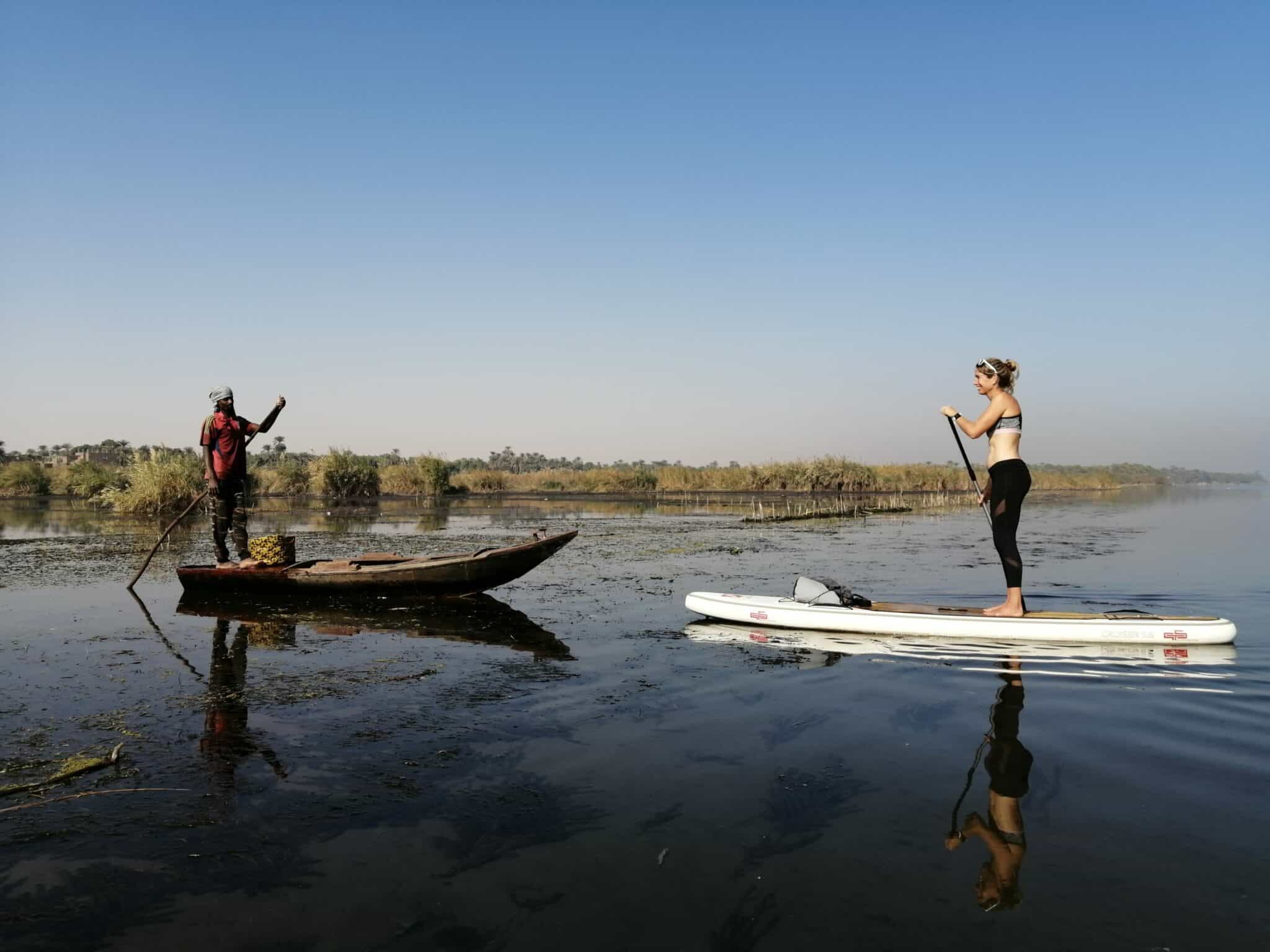
»Like many small oases, the Nubian villages nestle on the banks of the Nile«
It's always the same pattern that we noticed on our SUP vacation – irrigation canals, into which water is pumped from the Nile, create a 1-2 km wide green garden of palm groves and vegetable fields. The village then stands directly behind it, so as not to waste fertile soil on the border with the great sand sea of the Sahara.
Our destination on the 2nd day of the Stand Up Paddle tour was Kom Ombo, 47 km north of Aswan.
With a slight headwind and all our small stops, we paddled about 5-6 km per hour. Often we were invited for tea by fishermen who had gas stoves on their boats, so we moored our SUPs in the middle of the Nile at fishing boats for a tea chat. Shortly before Kom Ombo, we saw more camels on the banks of the Nile. We stopped in Daraw, because on weekends there is one of the largest camel markets in Egypt here. The camels come from Sudan and are transported by truck towards Cairo, where they are slaughtered for camel meat. At sunset we reached the Kom Ombo Temple, which is located directly on the banks of the Nile.
We caused quite a stir when we moored our SUPs directly between the Nile cruise ships. Since our felucca had to tack in the light headwind and moved slower than we did, we had time to meet people along the way or discover forgotten, hidden temples directly on the bank. Thus, 60km north of Aswan, we found a temple at Gebel el-Silsila hidden in the reeds, much less frequented by mass tourism than Kom Ombo, as only feluccas stop here at most.
»At sunset we reached the Kom Ombo Temple«
Nile cruise ships only stop for a photo from onboard. The rocks of the Eastern and Western Desert converge so closely here that the Nile Valley becomes particularly narrow, allowing for a relaxed day on the SUP, as the strong current means you hardly need to paddle. Sandstone has been quarried here since ancient times. Numerous Upper Egyptian temples were built from the sandstone of these quarries. The stones were shipped to Karnak, Luxor, Kom Ombo, Esna, Edfu and many other places in Upper Egypt. In open-cast mining, cuts up to twenty meters high were sometimes made into the rock to get to the coveted building material.
We hid our boards in the reeds and set off.
With a little luck, the temple guardians often unlocked tombs or sealed temple doors. The days on the Nile were similar, the landscape was characterized by donkeys and cows, sometimes even camels, grazing on the banks. Banana and sugar cane plantations as well as date palm groves alternated, behind which one could see the sand dunes of the desert. Hourly one heard the horn of the train connecting Cairo and Aswan, which is probably the fastest means of transport along the Nile after the airplane. In Esna, we said goodbye to our boat crew: our bed and luggage transport, which had followed us, now left us and we continued paddling solo without boat support. Our minimal luggage consisted of 2 sleeping bags, 3 T-shirts, toothbrush, money, cell phones and cameras. North of Esna there were significantly fewer feluccas, from time to time dahabiyas, the Nile houseboats, still passed us, but otherwise it became much quieter on the river.
The cruise ships would only pass us in columns of 6 or 7 ships in the mornings or evenings, as they usually docked at the temples in the morning and sailed from place to place at night.


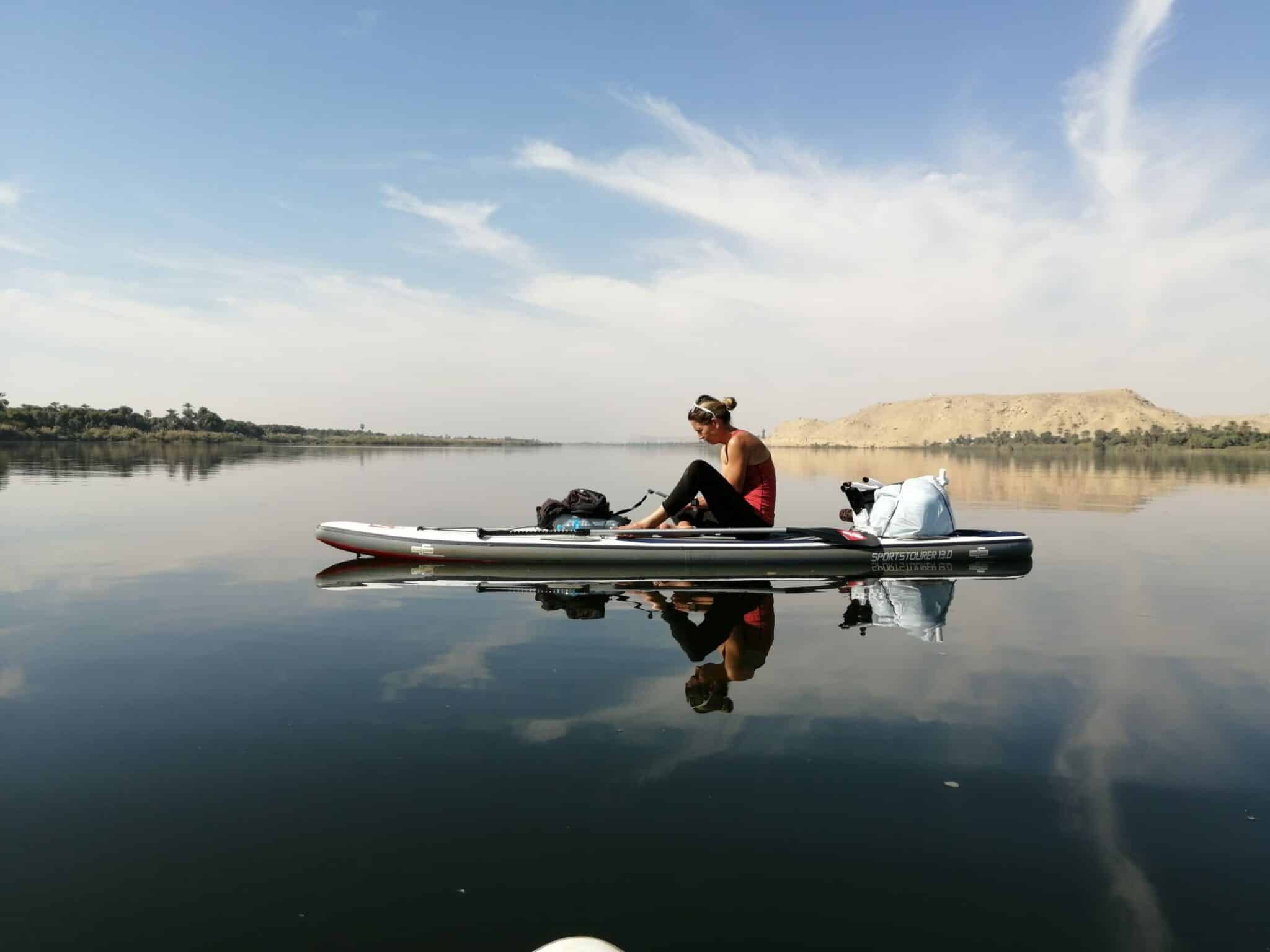
»GTS Boards are an excellent bed substitute for camping on a SUP vacation«
With 25-30 km per day, we made good progress, bought bread, feta cheese, and tomatoes in small shops on the banks, and learned that there's always time for tea. The children were proud each time they could try out our SUPs or we took them for a small paddle tour on our boards. We spent the night in banana plantations or undisturbed on the islands in the Nile on our boards in sleeping bags. GTS boards are an excellent bed substitute for camping. Provisions can be easily stocked up in the city souks. For history buffs, in addition to Edfu & Esna, there are countless temples and tombs off the beaten path to explore, e.g., El Kab or the Al Kola pyramid. So we spent the unpaddleable day with almost 30 knots of wind as amateur archaeologists. It's incredible how well preserved these 3000-3500 year old witnesses of history are.
It is amazing how colorful and detailed the drawings are, reflecting life on the Nile at that time. Our last day towards Luxor – 30 km to paddle – was rewarded with a good current and tailwind, so we arrived at the Luxor Bridge by noon, 3 hours earlier than expected. From there, we were accompanied for the first time by a tourist police boat. Here, the extent of the missing tourism since the revolution and now after Corona became clear. About 50 cruise ships lay stranded at the city entrance to Luxor on the banks of the Nile.
Our tourist police boat accompanied us directly to the hotel, where we could check in by SUP, as many of the hotels are built directly on the bank. After 9 days on the Nile (one of which was unpaddlable) and 200 kilometers paddled between Aswan and Luxor, we saw the sun set over the west bank one last time. With many interesting stories, small adventures, and a thousand new impressions, we finally ended our tour with a farewell paddle to the west bank, to visit the Valley of the Kings and the Colossi of Memnon, as well as the Hatshepsut Temple by bicycle.
Text & Pictures: Kathrin Borgwardt
- Choosing a selection results in a full page refresh.
- Opens in a new window.